Humanities 110 explores how people living in diverse historical contexts have engaged fundamental questions about human existence.
What are the humanities?
“The humanities” referred originally to the study of texts written by human, rather than divine, hands. In modern education, the humanities include the study of literature, history, philosophy, religion, politics, and the arts. Students of the humanities consider how people have represented and reflected on the physical, social, psychological, and ideological features of their worlds. We investigate the various materials that form the basis of cultures and identities and that simultaneously provide key terms for their critique and transformation. Possible questions include: How have different people distinguished appearance from reality, nature from culture, particular from universal? How have they made sense of the connection between the individual and the collective? How can we understand the relations between reason and desire, word and deed, the worldly and the transcendent?
What do we study?
Humanities 110 introduces students to humanistic inquiry by considering a range of artistic, intellectual, political, and religious strategies that emerged in different geographical and temporal contexts. The course examines how varieties of human thought interact to produce distinctive ways of life. Recognizing that no community is self-contained, we seek also to interpret texts as artifacts of cultural exchange, influence, and differentiation.
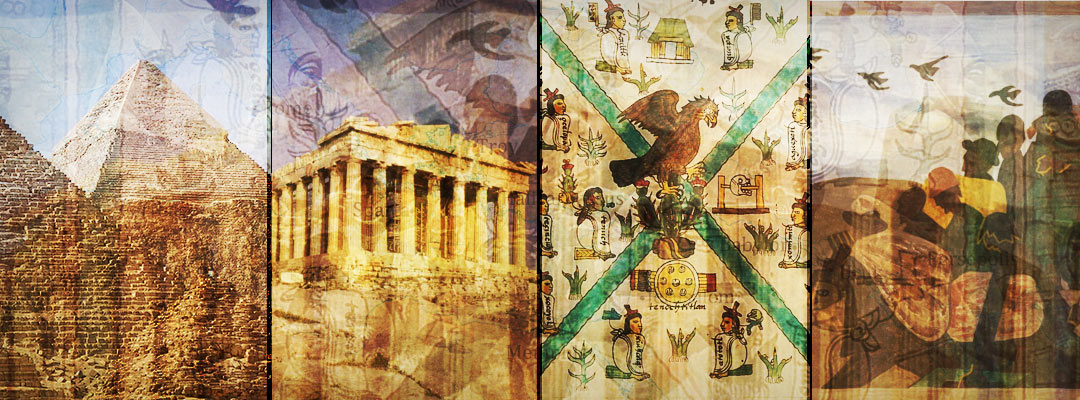
In 2023-2024, we will examine these questions within two broad contexts: the ancient Mediterranean world and North America from the early modern period to the twentieth century. The fall semester is divided into a sequence of units spanning ancient Sumer and Babylon, Pharaonic Egypt, ancient Israel and Yehud, the Persian empire, and the archaic and classical Greek city-states, particularly Athens. The spring semester examines Mexico, particularly the city of Tenochtitlan/Mexico City from the Spanish invasion to the twentieth century, and the United States, particularly Harlem in the 1920s. Themes include:
- The construction and interrogation of boundaries and hierarchies.
- Narratives of creation, whether of the natural world or the social world.
- Heroic values, epic, and responses to them.
- The ways in which difference is constructed, utilized, and reframed.
- The relationship between democracy, citizenship and exclusion.
- The relationship between truth, speech, and political power.
- Survivals, translations, and resistant in a colonial context, and the ways in which history, place and identity are continually created and re-created.
- The construction and narration of the modern nation state.
- The imposition of hierarchies of class, race and gender, and the ways they are negotiated and resisted.
- Modern literary and artistic forms of the Black diaspora, and the relationship between artistic creation and social and political transformation.
What do you learn and practice?
Humanities 110 serves as the college’s foundational writing course and introduces students to the skills and habits of mind necessary for academic inquiry in their future work at Reed. After successfully completing the full Humanities 110 course, students will be able to:
- craft, analyze, critique, and defend arguments using evidence;
- express ideas in writing persuasively;
- frame questions that elicit productive analysis;
- contribute constructively to a classroom discussion.
Over the course of the year, we also hope that you will develop your intellectual curiosity and develop a sense of what kinds of work or project you might pursue in a variety of the majors that the College offers.