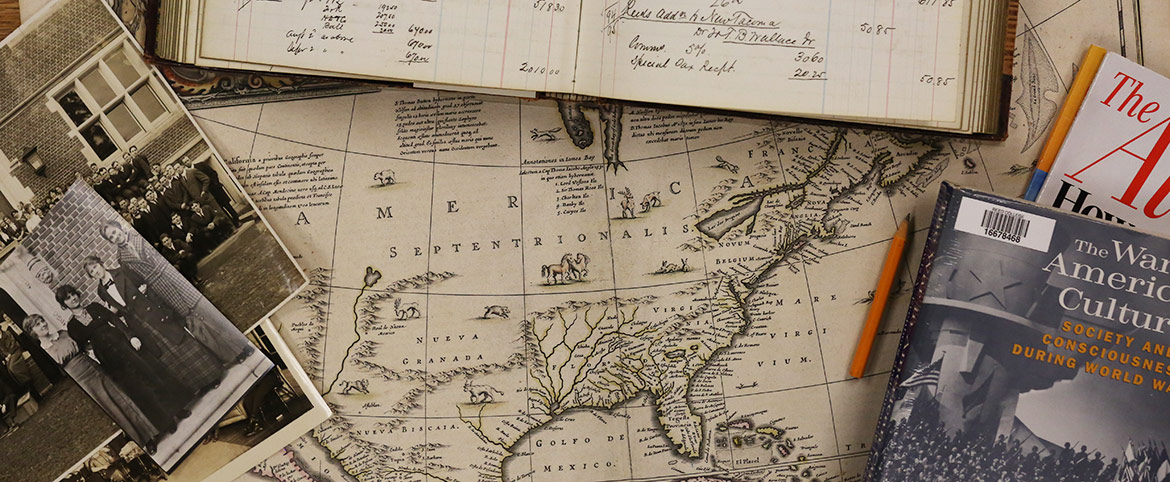
History majors at Reed develop a broad range of analytical skills in order to better understand the legacy—conscious or unconscious—that each present has inherited from its past and the many perspectives one can have on those legacies.
The department offers courses that cover a variety of periods and areas of study. Rather than focusing on specific coverage of conventional fields, however, the program exposes students to the diversity of approaches to studying the past, including social, intellectual, economic, cultural, gender, legal, and imperial, with the aim of developing students’ abilities to conduct independent inquiry and craft their own analytical and critical interpretations of the past.
Faculty areas of research include, amongst others, modern Europe; revolutionary-era France and Europe; colonial and revolutionary America; nineteenth-century United States; Middle Eastern and Ottoman history; U.S. women’s history; environmental history; Native American history; modern China and Japan; Latin America; Russia, and the history of science.
“At Reed, history is not just about truth-telling, though we do careful research and denounce plagiarism and inaccuracy. Instead, it is about crafting a narrative and making sense of the past, a place that is both strange and sometimes eerily familiar.”
—Isabel Lyndon ’17
The skills our students develop—including the close analysis and careful interpretation of textual, visual, aural, and other sources; the capacity to develop and critique interpretations and arguments; and effective reading, writing, and speaking skills—are carried over to a variety of fields upon graduation. In addition, Reed ranks number two in colleges and universities that send students to graduate and professional programs in history.
Related Fields
Courses offered in the history department, such as the History of Science, Making Race, Water and the American West, and Japanese Modernities, have close ties with the fields of science, anthropology, environmental studies, and literature. A new major in Comparative Race and Ethnicity Studies (CRES) is intended for students who wish to combine focused study in anthropology, dance, history, music, sociology, or theatre with comparative interdivisional work on race and ethnicity. Established interdisciplinary programs in American Studies, History-Literature, and Environmental Studies allow for innovative areas of study and a wide range of careers after graduation.
What Do Alumni Do?
- Executive Assistant & Library Specialist, National Indian Child, Welfare Association
- April Ybarra ’09
- Legal Advocate, Mazzoni Center
- Erica Briant ’07
- Judge, Oregon Department of Justice
- Luke Stanton ’02
- Senior Humanitarian Advisor, U.S. Foreign Disaster Assistance, United States Agency for International Development
- Sam Vigersky ’02
- Assistant Professor, Urban Affairs, University of Louisville
- Lisa Björkman ’00
- Production Assistant, NPR’s All Things Considered
- Alexi Horowitz-Ghazi ’14