The Immortal Jellyfish
Biology 342 Fall 2011
Eric Van Baak
The Immortal Jellyfish: Turritopsis Nutricula
The problem of aging is universal to organisms whose cells undergo mitosis: every time a chromosome is copied, the end of the chromosome degrades. The ends of chromosomes are "capped" with telomeres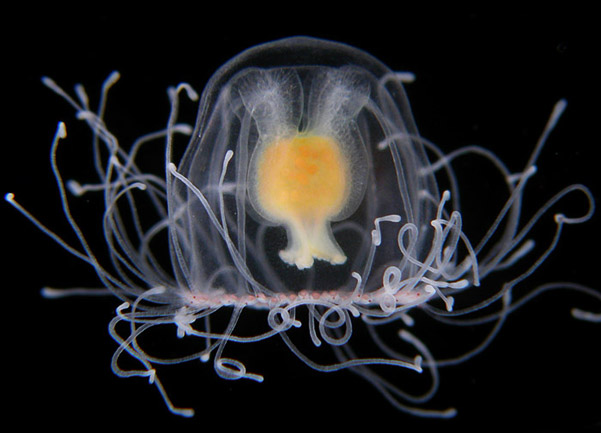 , buffers that prevent more important parts of the chromosome from being damaged. Telomeres are consumed during mitosis and afterwards replenished; once theycan no longer be replenished, the cell is destroyed by apoptosis to prevent chromosomal damage. This is the cellular basis of aging: cells that have divided too many times are destroyed, slowly weakening and eventually killing the organism.
The jellyfish Turritopsis nutricula, however, does not seem to care about this limit. To understand why, we need to consider the life-cycle that T. nutricula shares with most other hydrozoans: starting as an immature stationary form called the polyp, it eventually metamorphoses into the more familiar shape we associate with a jellyfish: the medusa.
Many jellyfish species survive as medusas only long enough to reproduce, if even that. The fragility of the medusa form is, indeed, quite likely to result in death before they have had an opportunity to pass on their genetic material. Turritopsis, however, has a way of dealing with this problem. It does not need to remain a medusa; it can easily transform back into polyp form, bud off again as a medusa and, theoretically, repeat the process as long as is necessary.
This backflow of the normal larva-to-adult metamorphosis, perhaps unique in the animal kingdom, allowsTurritopsis nutricula to metamorphose back into an immature form and restart its life cycle, bypassing organismic death in situations where it would normally be unavoidable.
(image: http://www.scientificamerican.com/media/gallery/031532AD-F8EF-2D66-1D266D5A39DFF114_8.jpg)